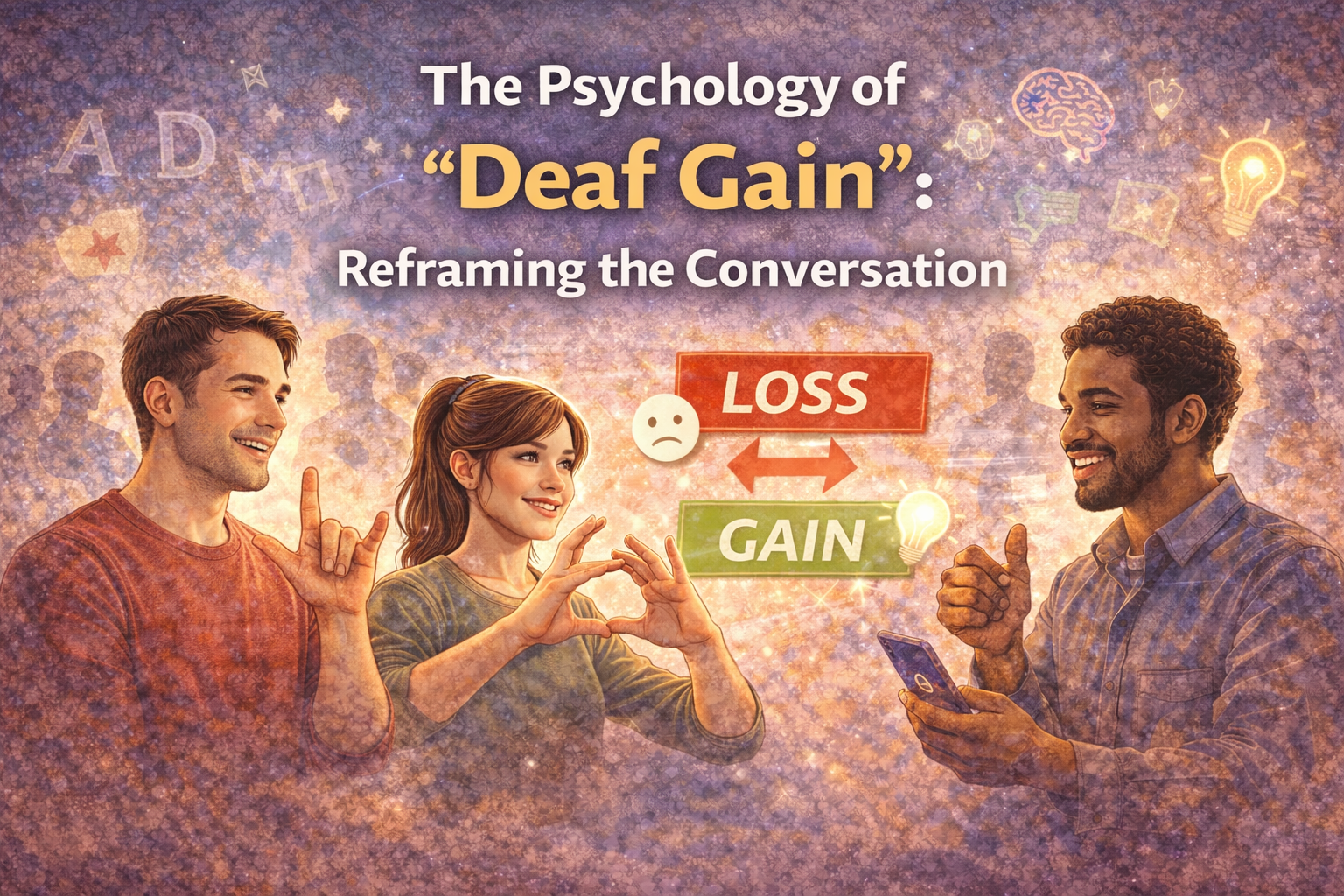
For generations, deafness has been framed as a deficit — something missing, something broken, something to fix. Medical models often describe hearing loss in terms of impairment. Words like “disability,” “deficiency,” and “limitation” dominate conversations.
But what if the conversation itself is incomplete?
What if deafness is not only about what is absent — but also about what is gained?
This is where the concept of Deaf Gain emerges. Deaf Gain shifts the narrative from focusing on loss to recognizing unique contributions, strengths, and perspectives that arise from being Deaf. It is not denial of challenges. It is not romanticizing barriers. Instead, it is a reframing — a psychological, cultural, and social shift in perspective.
In this article, we explore the psychology behind Deaf Gain, how it transforms identity, challenges traditional thinking, and opens new possibilities for understanding human diversity.

- What Is Deaf Gain?
Deaf Gain is a concept that suggests deafness brings valuable cognitive, social, and cultural contributions to society. Rather than seeing deafness purely as hearing loss, it recognizes:
• Enhanced visual attention
• Rich sign language expression
• Strong visual-spatial skills
• Deep community bonds
• Unique cultural traditions
• Alternative communication innovations
The term encourages us to ask a powerful question:
What does the world gain from Deaf people?
- The Psychological Power of Reframing
Psychology teaches us that the way we frame experiences shapes identity and self-esteem.
When deafness is described only as a problem, individuals may internalize feelings of inadequacy. Children especially absorb societal messages quickly. If society constantly communicates “you are missing something,” it affects confidence.
Reframing deafness as Deaf Gain changes that internal narrative.
Instead of:
“I am lacking something.”
It becomes:
“I experience the world differently — and that difference has value.”
This shift strengthens self-concept and psychological resilience.

- Identity Formation and Self-Worth
Identity is built through language, community, and social validation.
For Deaf individuals who grow up exposed to sign language and Deaf culture, identity often forms around pride rather than deficiency. They see deafness not as isolation, but as belonging to a vibrant linguistic and cultural minority.
However, when Deaf children grow up in environments where deafness is treated only medically, identity confusion can occur.
Deaf Gain helps bridge this gap by validating Deaf identity as positive and meaningful.
- The Medical Model vs. The Cultural Model
To understand Deaf Gain, we must compare two dominant frameworks:
The Medical Model
This model sees deafness as a condition to diagnose and treat. The goal is normalization — restoring hearing if possible.
The Cultural Model
This model sees Deaf individuals as part of a linguistic and cultural minority. Sign language, traditions, and shared experiences form a distinct community.
Deaf Gain aligns strongly with the cultural model. It does not reject medical care but challenges the idea that deafness must always be “fixed.”
- Cognitive Strengths Associated with Deafness
Research in psychology and neuroscience suggests that Deaf individuals often develop heightened visual processing skills.
Because auditory input is absent or reduced, the brain reallocates attention and processing resources.
Some observed strengths include:
• Peripheral visual awareness
• Motion detection sensitivity
• Enhanced facial expression recognition
• Advanced visual-spatial reasoning
These are not compensations — they are adaptations. The brain reorganizes itself in powerful ways.
That is gain.
- The Beauty and Complexity of Sign Language
Sign languages are complete, sophisticated languages with grammar, syntax, poetry, humor, and nuance.
They are not gestures. They are not simplified communication. They are rich linguistic systems.
Psychologically, using a visual language changes how information is processed. It engages spatial reasoning, facial expression, and body movement.
Sign language also fosters direct eye contact and emotional transparency, strengthening interpersonal bonds.
That is gain.
- Social Bonding and Community Strength
Deaf communities often exhibit strong social cohesion. Shared experiences create empathy and mutual understanding.
Community gatherings, storytelling traditions, and cultural events reinforce identity and belonging.
Psychologically, belonging is one of the strongest predictors of well-being.
When Deaf individuals connect within community spaces where communication flows naturally, mental health improves.
That is gain.
- Challenging the “Fix-It” Mentality
Modern technology offers hearing aids, cochlear implants, and advanced interventions. These tools can be life-changing for some.
However, the psychology of Deaf Gain reminds us that technology should offer choice — not erase identity.
When society implies that Deaf individuals must become more “hearing-like” to succeed, it invalidates cultural identity.
True empowerment means respecting multiple ways of being.
- Deaf Gain and Neurodiversity
The concept of Deaf Gain aligns closely with neurodiversity — the idea that neurological differences are natural variations of the human brain.
Just as society increasingly recognizes autism and ADHD as part of human diversity, Deaf Gain encourages recognition of sensory diversity.
Human experience is not one-size-fits-all.
- Language Access and Cognitive Development
Early exposure to accessible language is critical for brain development.
When Deaf children are given early access to sign language, cognitive development flourishes. Delayed language exposure, however, can create developmental challenges.
The gain is not automatic — it requires accessible communication.
The psychology of Deaf Gain emphasizes the importance of giving Deaf children the tools to thrive, not forcing them into inaccessible systems.
- Emotional Intelligence and Visual Communication
Sign language relies heavily on facial expressions and body language.
This often leads to heightened awareness of emotional cues. Some researchers suggest Deaf individuals may develop strong nonverbal communication skills.
Emotional intelligence is deeply tied to success in relationships and leadership.
Again — gain.
- Creativity and Innovation
Deaf individuals have contributed significantly to visual arts, performance, storytelling, and technology.
Visual storytelling techniques in film and digital media often draw inspiration from Deaf expression styles.
Innovation frequently arises from difference.
When people navigate the world differently, they create differently.
- Psychological Resilience
Living in a hearing-dominated world requires adaptation and strength.
Many Deaf individuals develop resilience from navigating communication barriers, advocating for accessibility, and challenging misconceptions.
Resilience is not born from hardship alone — it grows when individuals feel supported and valued.
Deaf Gain reinforces value.
- Breaking Internalized Audism
Audism refers to discrimination or prejudice against Deaf individuals based on the belief that hearing is superior.
When Deaf people internalize audism, self-esteem suffers.
Deaf Gain counters internalized negativity by affirming worth and contribution.
It dismantles hierarchy.
- The Role of Education in Reframing
Educational systems play a major role in shaping perception.
When schools focus only on speech training without validating sign language, they reinforce the idea of deficit.
When schools embrace bilingual approaches (sign language and written/spoken language), students thrive academically and emotionally.
Reframing begins in classrooms.
- Society’s Psychological Shift
Deaf Gain is not just about Deaf individuals changing how they see themselves.
It is about hearing society changing how it sees difference.
When society stops asking, “How do we fix deafness?” and starts asking, “What can we learn from Deaf perspectives?” inclusion becomes genuine.
- The Ethical Dimension
Reframing deafness as gain challenges ethical assumptions in medicine, education, and policy.
It encourages policymakers to:
• Invest in sign language access
• Improve captioning standards
• Promote inclusive design
• Respect Deaf leadership
Ethical systems should uplift diversity, not erase it.
- The Future of Deaf Gain
As awareness grows, Deaf Gain is influencing academic research, disability studies, and public discourse.
Future conversations may center on:
• Sensory diversity in workplaces
• Universal design
• Visual-first technology development
• Multilingual sign language education
The shift is gradual — but it is happening.
Conclusion: A Broader Human Perspective
The psychology of Deaf Gain invites us to expand our understanding of what it means to be human.
Hearing is one way to experience the world. It is not the only way.
Visual language, spatial awareness, emotional expression, and community strength are not compensations. They are variations of human brilliance.
Deaf Gain does not deny barriers. It does not ignore accessibility needs.
Instead, it says:
Difference is not deficiency.
Diversity is not damage.
And identity is not something to fix.
When we reframe the conversation, we do more than change words. We change minds. We change policies. We change lives.
And in doing so, society itself gains.